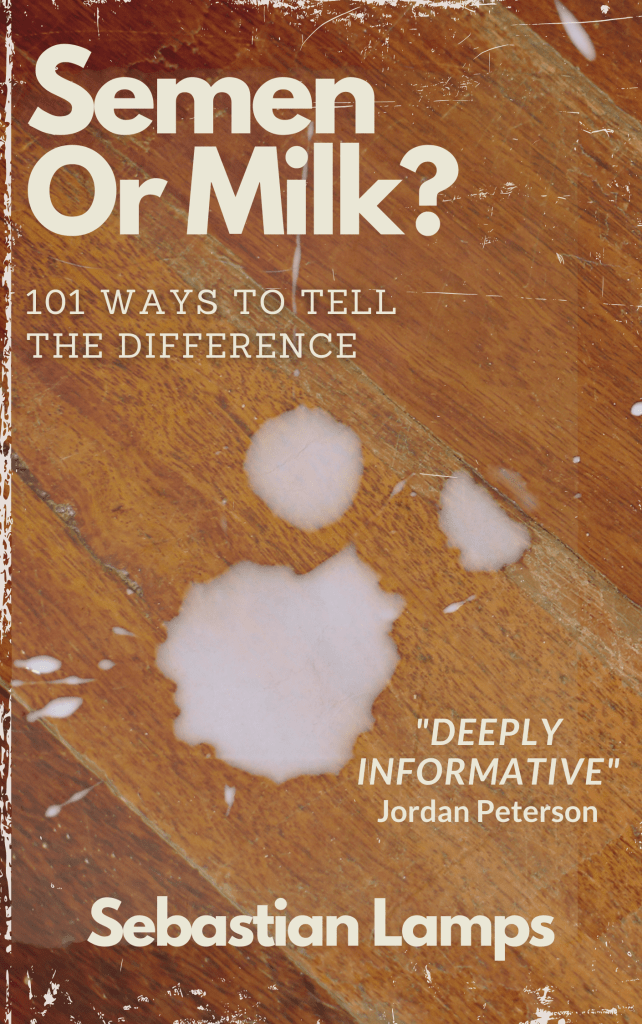
Semen or Milk by Sebastian Lamps was first released in 2012 and instantly gained notoriety for its subject matter.
The book and its topic soon became a focal point of a culture war, with many supporters on the right defending Lamps right to say and write whatever he wished. In contrast, his critics on the left said it was all a bit silly and that it’s easy to tell the difference, as milk comes from cows, and semen doesn’t.
The controversy did little to harm sales of the book, which has gone on to sell over 250 copies worldwide.
SYNOPSIS
From Sebastian Lamps, the author of Nipples or Raisins, comes a new and helpful guide to telling the difference between human semen and milk.
To the naked eye, semen and milk can look very similar, but confusion around both can lead to confusion, unwanted pregnancies and very salty-tasting breakfast cereals.
Lamps also covers the history of semen and milk, how the two have often been confused by the other, and how societies have evolved and adapted as we’ve begun to learn more about each substance.
But how, in this modern age, when people are surrounded by more distractions and seemingly on the go, can we tell? How do we know that the white liquid we’re taking out of the fridge is, in fact, milk and not a carton of reproductive fluid that has accidentally got mixed up or, even worse, has been purposely done as an act of revenge or terrorism?
This book will give you a head start on learning which and how to tell the difference!
Continue scrolling for an exclusive extract!

EXTRACT
Introduction
Semen or milk? Semen or milk? It is a question that has been asked by generation after generation, and it is easy to understand why.
At a glance, they indeed seem very similar, leading to confusion for people all around the globe. But they are both very different and, as many of us know, taste quite different, from the sour, dairy aftertaste of milk to the salty but sometimes sweet taste of semen.
Pouring the wrong one over your Coco-Pops in the morning could lead to a ruined breakfast.
If you’re feeling a little embarrassed about being unable to tell the difference, you’re not the only one.
The question of it’s semen or milk has a long history, and until the year 1239 AD, it was believed by the entire populace of the world that the milk we know today was, in fact, semen. Cows, goats, bees, and anything that produces milk were thought to be just completely full of cum.
But one morning in June 1240, a Spanish man named Marco Diaz from a small village called Mundane in the Basque region was discovered sucking a cow dry by the cattle’s owner. A trial was set up in the local court, with many locals believing it was an open-and-shut case.
Many villagers thought Diaz would be found guilty and sentenced to having sixty-nine cucumbers thrown at him, as was the punishment for any animal interference in 13th-century Basque.
But Diaz argued his case well, and soon, many of the local men began to try sucking a cow’s teat for themselves. This led the judge of the case to try for himself and declare that it “Tastes right nice and that!” before freeing Diaz.
Word of the discovery soon began to spread quickly like some kind of fire that was wild.
Thirty years later, Eric Bumgarter hit upon the idea of emptying the milk from the animal into a bucket rather than sucking it straight from the animal, thus curing a growing number of back ailments as well as kickstarting modern cattle farming as we know it today.
Discover more from ForgottenBooksOrganisation
Subscribe to get the latest posts sent to your email.
 ForgottenBooksOrganisation